

Jason just opened his Cox bill.
$482.
For three phone lines and a fax machine he hasn't used since 2019.
There's a note at the bottom telling him the price is about to go up AGAIN because his plan is "obsolete."
Here's what's worse.
While he was staring at that bill, his phone rang. He didn't get to it in time. The customer hung up and called the next HVAC company in the Google results.
That one missed call cost him more than the entire phone bill.
If you're running an HVAC business on old landlines in 2026, this is your life now.
You're paying premium prices to miss money calls.
Let's fix both.
The Real Cost of a Landline Isn't the Bill. It's the Missed Revenue.
Let's start with the obvious number.
Jason's Cox bill was $482 a month for three lines and a fax machine he hadn't used since 2019.
That's $5,784 a year.
And Jason isn't even getting the worst of it.
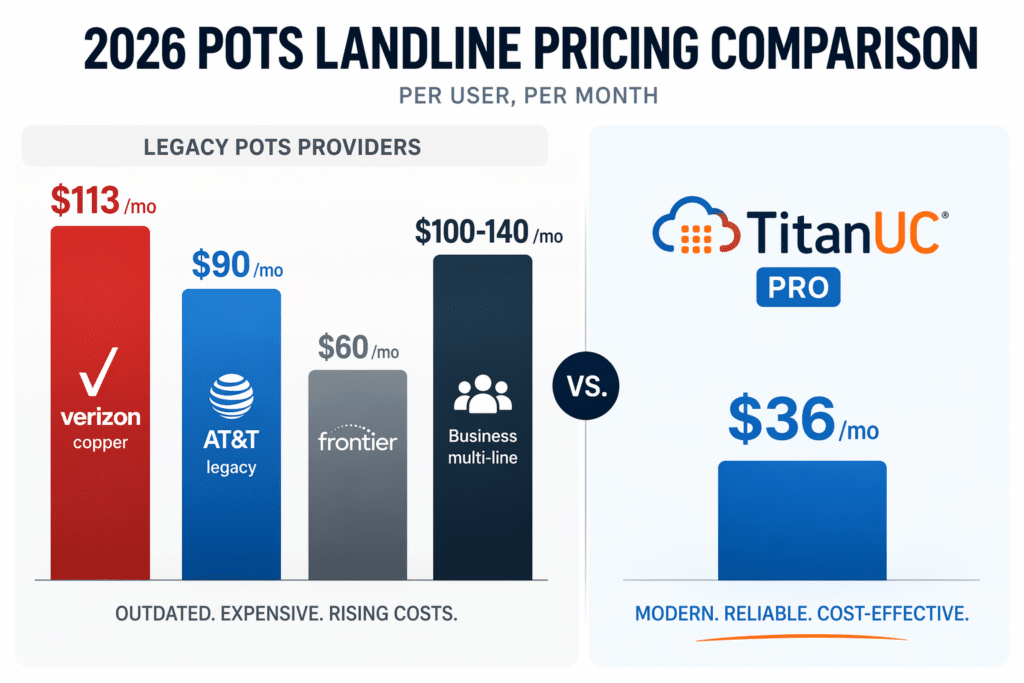
Here's what real small business owners and homeowners are reporting they're paying for basic copper POTS service in 2026, pulled from Reddit threads, Facebook groups, and X posts:
- $113 a month for a single Verizon copper line in a rural area.
- $90 a month for a legacy AT&T line, just to keep it active.
- $60 a month on Frontier and climbing every renewal.
That's RESIDENTIAL service. For ONE line.
Business multi-line setups routinely hit $100 to $140 per line. Multiply that by three lines plus a fax, and you land right where Jason is.
He's not being gouged. He's paying the going rate.
And what was he really buying?
- A phone system tied to a desk.
- A setup that can't follow him into the truck.
- A system that makes it easier to miss calls when he's on a job, in the warehouse, or helping a tech solve a problem.
- A provider that's already telling him the old plan is obsolete and the price is going up.
So he's paying premium money for a shrinking asset.
That's bad enough.
But here's where it gets ugly.
If even 10 good calls a month go unanswered, and just 3 of those would've turned into service calls worth $250 to $600, the real loss isn't $482.
It's thousands.
And if one of those calls was a system replacement lead worth $8,000 to $15,000, now you're not talking about a phone bill. You're talking about financial self-sabotage.
Why This Is Happening Now
The big carriers aren't hiding it anymore.
Copper lines are old. Expensive to maintain. Harder to support every year.
Back in 2019, the FCC opened the door for carriers to back away from maintaining old copper infrastructure. Since then, small business owners have been getting squeezed. Higher rates. Worse support. More pressure to move off the old setup.
That's why your bill keeps climbing while the service feels more and more like an afterthought.
They're not raising prices because the value got better.
They're raising prices because they want you off the line.
This has a name. Industry insiders call it "discouragement pricing."
Charge enough that you leave on your own. That way the carrier doesn't have to keep maintaining the equipment, doesn't have to answer support calls about it, and doesn't have to send a truck to your business when the line goes down.
The slow squeeze is the whole strategy.
The note at the bottom of Jason's bill telling him his plan is "obsolete" isn't a warning. It's an eviction notice with a smile on it.
Not theory. Not hype. Just economics.
The Question Isn't "Is VoIP Perfect?"
The real question is this:
Will your next phone system help you capture more leads than the one you've got now?
Because if it won't do that, nothing else matters.
A thousand features mean nothing if your phones still miss calls.
For an HVAC business, the phone is a cash register.
It rings, you answer, you book work.
It rings, nobody answers, your competitor books work.
That's the whole game.
Old Landlines Are Built for a Business That Doesn't Exist Anymore
There was a time when the phone sat on the front desk and the person near the phone answered it.
That world is gone.
- Now the owner is in the field.
- The dispatcher is stepping away.
- The office manager is on another line.
- The tech grabs the call because he's closest to the customer.
- The lead comes in at 6:12 p.m. while you're locking up.
Old landlines don't help with that.
They make you hope someone is standing in the right place at the right time.
Hope isn't a phone strategy.
What VoIP Does That a Landline Can't
VoIP turns one business number into a lead-capture system.
- The office phone rings.
- Your cell rings.
- Your dispatcher rings.
- Your after-hours setup routes calls where they need to go.
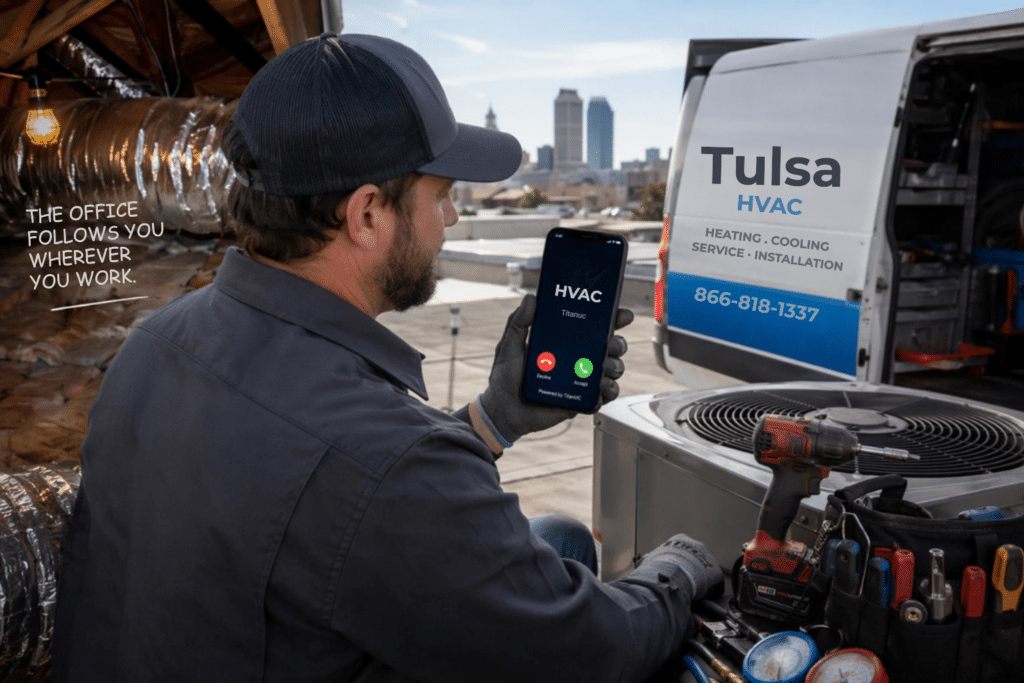
- You answer from the shop, the truck, the house, or the attic.
That matters because HVAC leads are impatient.
Nobody with a dead AC in July wants to leave a voicemail and wait for a callback tomorrow.
They want a human now.
With TitanUC, Jason's calls hit the desk phone AND his mobile app at the same time. He answers with his business caller ID, not his personal number. He keeps the office number in front of the customer while the call follows him wherever he is.
That means fewer missed calls.
Fewer missed calls means more booked jobs.
More booked jobs means more money from the same marketing spend.
That's why the math pencils out fast.
Here's What the Numbers Look Like
Jason was paying $482 a month.
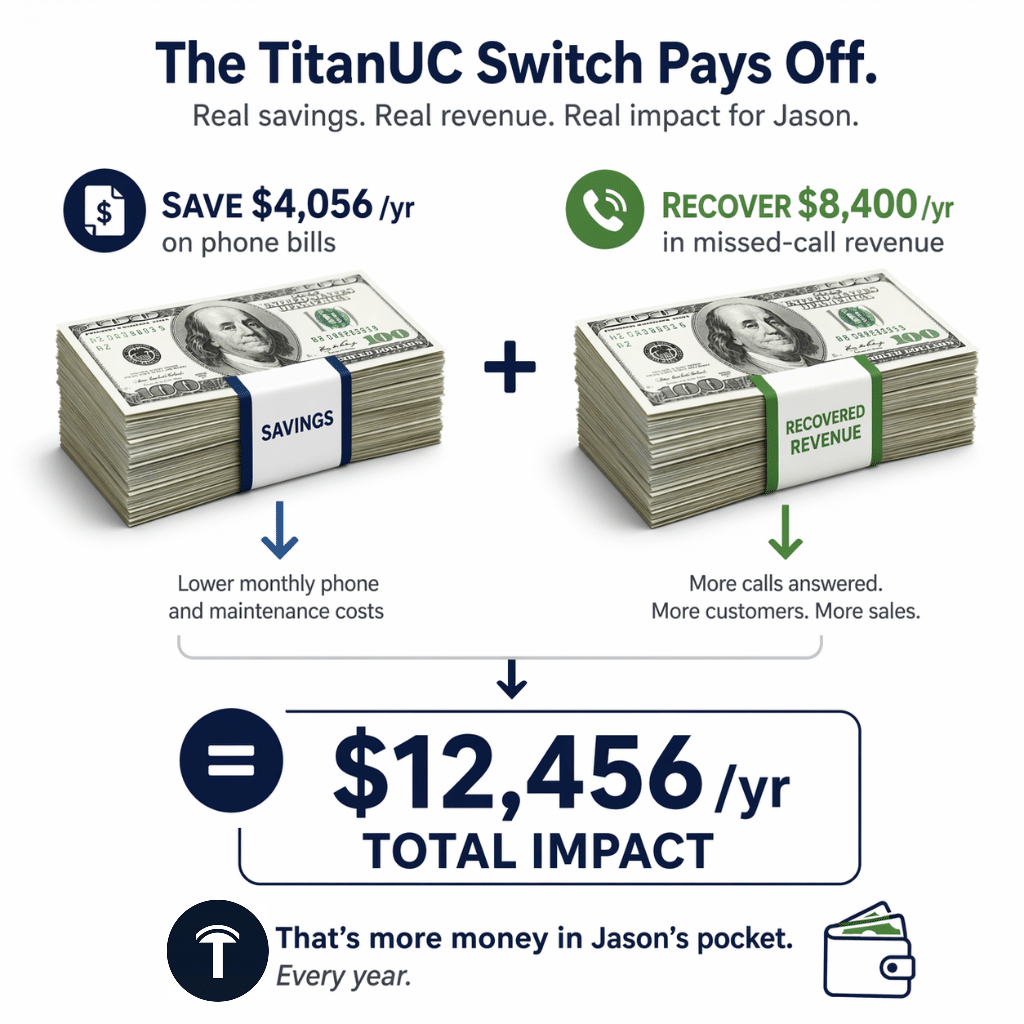
On TitanUC Pro, he'd pay $36 per user, per month.
If he needs 4 users, that's $144 a month.
That's a monthly difference of $338.
That's $4,056 a year.
That alone gets attention.
But the bill savings are still the small play.
Let's say better call handling helps him save just 2 jobs a month that would've otherwise gone to voicemail or to a competitor.
If those jobs average $350 each, that's $700 a month recovered.
Over a year, that's $8,400.
Add the phone bill savings, and now you're looking at $12,456 in combined impact.
And that's using conservative numbers.
If even one replacement lead gets saved because the right person answered at the right time, this whole conversation gets decided in a hurry.
Why Most Phone Companies Still Get This Wrong
Most phone companies sell features.
Smart apps. Dashboards. Reporting. Fancy terms.
Fine.
But Jason doesn't need a software demo. He needs the phone answered when money calls.
That's why the wrong provider will still waste your time even if they're technically "modern."
Here's what actually matters.
1. The Price Has to Stay the Price
If somebody tells you $19.99 and the bill shows up at $45 after mystery fees, you've got a liar, not a partner.
This isn't a small thing. Real users on Reddit are reporting 10 to 20 percent in mystery surcharges, regulatory recovery fees, 911 fees, long-distance fees, and "technology" fees stacked on top of the base rate.
A $45 base bill becomes $54 in your bank account. A $90 line becomes over $100. Over a year, that's another $120 to $1,200 you didn't sign up for.
TitanUC's $36 is $36. We don't play that game.
TitanUC Pro is $36 per user per month.
Month to month. No contract. No setup fee. Free number porting.
Want to see what your bill looks like on TitanUC? Run the numbers right now. Takes 30 seconds: calculate your new phone plan.
2. The Call Has to Follow the Money
If the phone only rings on a desk, it's built to lose leads.
Your business number needs to ring where your people actually are.
That's how you stop wasting ad dollars.
3. Support Has to Answer When Things Go Sideways
When phones are acting up, you don't need an offshore script reader asking you to reboot something for the ninth time.
You need a real person who can help.
TitanUC is based in Tulsa. A real human answers.
That's a bigger deal than most owners realize until the day they actually need it.
4. You Should Be Able to Leave If It Doesn't Work
The big carriers love long contracts because long contracts protect bad service.
We don't do that.
Month to month.
If the service isn't doing the job, you shouldn't be trapped.
"But What About My Existing Phones?"
Fair question.
A lot of HVAC owners think switching means ripping everything out and starting over.
It doesn't.
If you want new desk phones, you can get them.
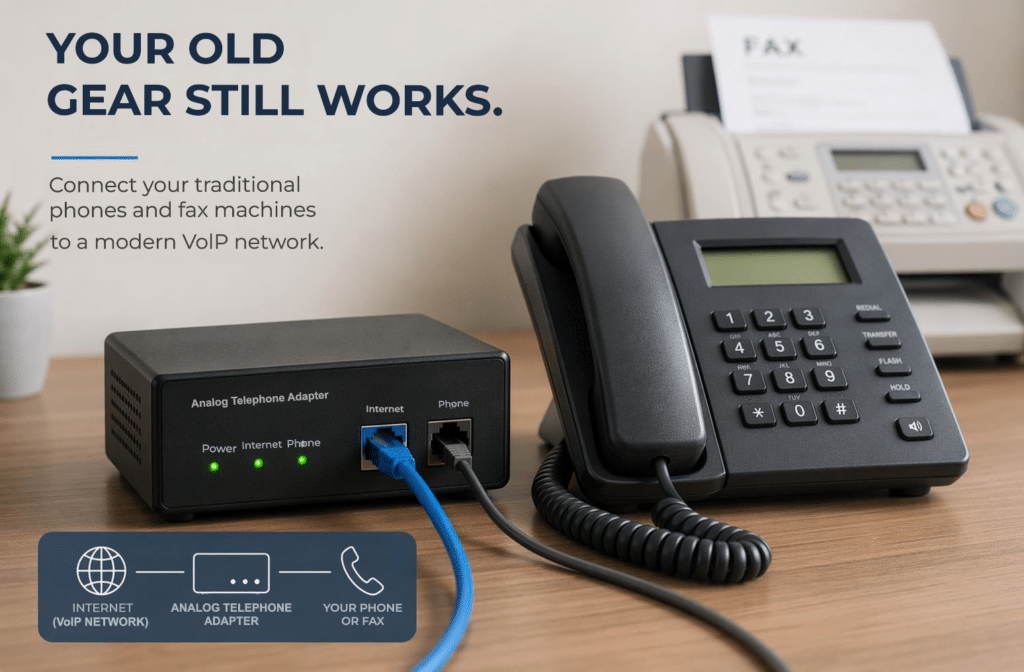
If you want to keep older analog phones or a fax line, use an ATA, an Analog Telephone Adapter, to connect them to the new setup.
That means you don't have to throw away working equipment just to stop overpaying.
So if you're thinking, "I don't want a big complicated change," good. You probably don't need one.
You need the business number to keep working, route better, and cost less.
That's a very different thing.
What About My Alarm System, Fax, or Medical Alert?
This is a top-5 complaint on social media: people switch to VoIP and realize their home alarm or medical alert pendant is now a paperweight. They get furious, and they should.
We handle it differently:
- Alarm Systems: Often need an IP dialer or cellular module. We'll tell you upfront what your panel needs and if needed we will work with a local alarm company to coordinate the swap.
- Fax Machines: These can work via an ATA, but we usually recommend e-fax. Why? Because the same packet-loss issues that hurt VoIP voice quality can mangle fax tones.
- Medical Alerts: These should move to cellular-based units. We'll point you to the providers we trust.
- Hard-of-Hearing Devices: TTY or captioned phone equipment may need replacement. We test yours during the parallel setup so you know for sure before you port.
We tell you the truth about your equipment BEFORE the port, not after.
"What About Porting My Number?"
Also fair.
Your number is on your trucks, your website, your invoices, your business cards, and probably a thousand places you forgot about.
You can't afford to lose it.
You shouldn't have to.
We handle porting for free.
Porting takes 5 to 10 business days. Period.
During that time, your old system stays up while the new one gets set up in parallel. You can test it. Make sure it works. Then the number moves over.
That's how you reduce risk.
And that's why switching doesn't have to mean going dark.
Look. We know what's on Reddit. We know what people post on Facebook after a power outage takes their phones down for two days. We've read every complaint. Here's the truth: VoIP done wrong is worse than copper. VoIP done right is better. The difference is the provider.
Let's Talk About the Fears, Because They're Real
VoIP has three weak spots. Here they are. Here's exactly how we kill each one.

Power Outages
This is the #1 complaint we see on Reddit and X. We get it. People say, "In the good old days the telephone would always work." They're right. Old copper lines carried their own voltage from the central office, so the lights could be out for a week and your phone still worked.
If your VoIP setup only has one layer of defense, you're in trouble during a bad storm. I'll tell you three:
- UPS battery backup on your router and phones to keep the desk units live for the first few hours.
- The mobile app keeps your business number alive on cellular data. Even if your office is dark for a week, your phone works in your pocket.
- Optional 5G failover for your router, so your internet stays up even if the physical line is cut.
Internet Issues
If your internet is junk, your phone experience is junk. You've seen the complaints on Reddit: latency, jitter, dropped calls, and echo.
Most shops run voice over the same network as video calls, security cameras, and the breakroom radio. The phones usually lose that fight.
We set up QoS (Quality of Service) prioritization so your voice traffic always gets the right of way. For shops with shaky internet, we recommend a dedicated 5G failover line. It costs less than what you're already saving on the bill, and it's better than the alternative: explaining to a customer why you sound like you're calling from inside a tin can or you have robot voice.
E911
Here is exactly what we do:
- We register the physical address tied to every single desk phone during installation.
- Every mobile-app user is prompted to verify their current location for accurate E911 routing.
- If our system detects an incomplete or missing address on any line, our team calls you and walks you through it before the line ever goes live.
We don't leave 911 to chance. Period.
Why Staying With Cox or AT&T POTS Line Service Is a Terrible Business Decision
Let's call it what it is.
If you're paying rising rates for old landline service that keeps your team chained to a desk and makes it easier to miss leads, you're making your business less efficient on purpose.
Not because you're careless.
Because you got busy. Because the phones still "worked." Because changing it sounded annoying.
That's how bad expenses survive for years.
They don't look urgent until you do the math.
Then you realize the old setup has been draining money the whole time.
- High monthly cost.
- Missed inbound calls.
- Slow response.
- Wasted ad spend.
- Lost jobs.
- No mobility.
- Bad support.
- Contract traps.
- Extra charges to port your number.
That stack of problems is why this isn't a tech decision.
It's a profit decision.
Why TitanUC Fits an HVAC Business
We're not trying to impress you with corporate theater.
We're trying to help you stop bleeding money on a phone setup that doesn't match how your company actually operates.
TitanUC gives you three straightforward options:
- Starter: $28 per user per month.
- Pro: $36 per user per month.
- Call Center: $45 per user per month.
Most HVAC companies looking for mobile apps, business texting, call recording, and voicemail transcription end up looking hardest at Pro.
- Month to month.
- No contract.
- No setup fee.
- Free number porting.
- Works with existing hardware (may need ATA device).
- Setup in about 24 hours.
- Tulsa-based support that answers.
You can browse the options in our online shop.
If you want the short version, this is it.
You need a phone system that helps you answer more revenue calls for less money.
That's what we're built to do.
If You're Still Asking "Can VoIP Replace My Landline?" Read This
A landline can still make a dial tone.
Fine.
But Jason doesn't need a dial tone.
He needs booked jobs.
- He needs the number to ring where his people are.
- He needs the customer to reach a live person fast.
- He needs to stop paying almost $500 a month for yesterday's infrastructure.
- He needs support he can call.
- He needs to keep his number.
- He needs the switch handled without chaos.
That's why the answer is yes.
VoIP replaces your landline.
More important, it outperforms it where the money is made: lead capture, speed to answer, flexibility, and ROI.
FAQ for HVAC Owners Thinking About Switching
Can I keep my business number?
Yes. We handle number porting for free, and that's a big deal when your number is already on your trucks, website, and ads.
Will my calls ring on my cell phone too?
Yes. With the right setup, your business number rings your mobile app so you can answer when you're away from the desk.
What happens if the power goes out at the office?
Desk phones go down if power AND internet are both out. But your system stays in the cloud. You keep answering through the mobile app. A small UPS battery backup also keeps the desk phones alive.
Do I need all new phones?
You can keep your existing phones in most cases. We'll tell you upfront if yours aren't compatible. You can also use an ATA for older analog devices.
How fast can this be set up?
We get your system ready in about 24 hours. Number porting takes 5 to 10 business days. Period.
Real People Ready to Answer Your Call
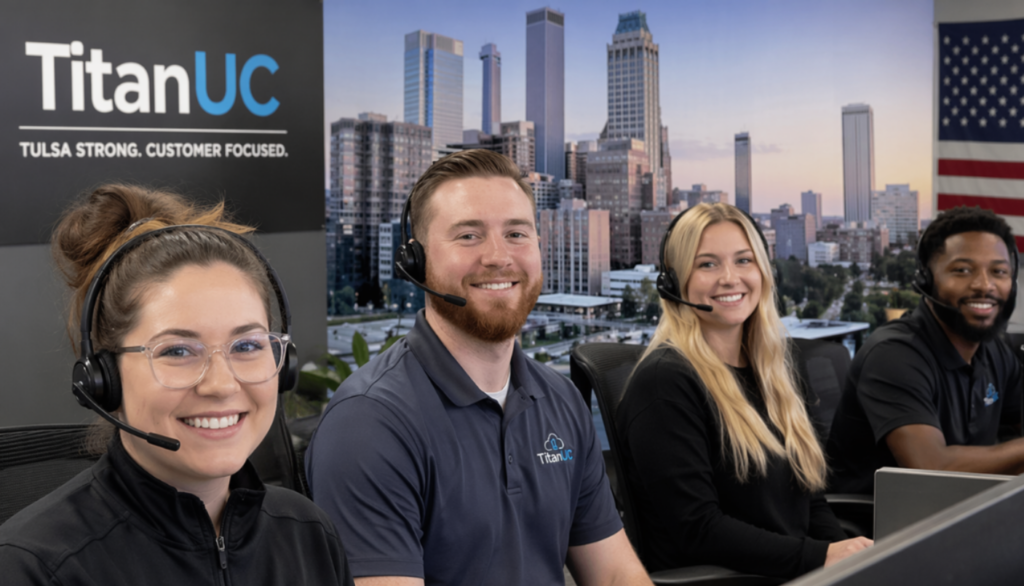
Look. Every month you stay on Cox, they cash another $338 of your money. Every week you wait, more calls go to voicemail and more leads call your competitor. The fix takes 24 hours to set up. Your number ports in 5-to-10 business days with zero downtime.
Book the 15-minute call. Or pick up the phone right now and dial 866-818-1337.
A real human in Tulsa picks up. No script. No queue. No offshore call center. Just somebody who can have your new system live before the week is over.
P.S. While you're "thinking about it," your phone is ringing right now and somebody's not answering it. Every missed HVAC call is the $300 you spent to make it ring PLUS the $1,500 ticket you didn't book. Do that math for a single month. Then pick up the phone: 866-818-1337.

0 Comments